
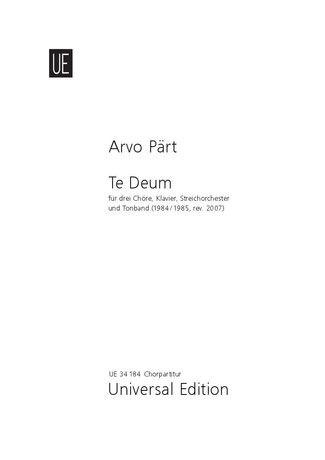
Arvo Pärt
Te Deum
für Chor SSAA/TTBB/SATB, präpariertes Klavier, Streichorchester und Tonband (Windharfe)
PDF
voir
Arvo Pärt
Te Deum
für Chor SSAA/TTBB/SATB, präpariertes Klavier, Streichorchester und Tonband (Windharfe)
- Formation Choeur de femmes (SSAA), Choeur d'hommes (TTBB) et Choeur mixte (SATB)
- Compositeur Arvo Pärt
- Édition Partition de chœur
- Maison d’Édition Universal Edition
- N ° de commande UE34184
 disponible
sera expédié dans 1-2 jours ouvrables
TVA incluse,
Hors frais de port
Non disponible dans tous les pays. Apprendre encore plus
Description:
Pärt's take on the Te Deum text, also known as the Ambrosian Hymn, employs his signature tintinnabuli style of composition. The melodic lines, as well as their harmonies, strictly follow the rhythms of the text, resulting in heightened importance given to the text itself and an unconventional setting. For advanced players and vocalists. The liturgical text of the Te Deum consists of immutable truths. I am reminded of the sense of immeasurable serenity imparted by a mountain panorama. Swiss artist Martin Ruf once told me that he can distinguish over twenty shades of blue in the mountains when the air is clear. His words immediately turned into sound; I began to hear those blue mountains. I wished only to convey a mood, a mood that could be infinite in time, by delicately removing one piece - one particle of time - out of the flow of infinity. I had to draw this music gently out of silence and emptiness. The work Te Deum was a quest for something evanescent, something long lost or not yet found, the quest for something believed to be non-existent, but so real that it exists not only within us but beyond our being as well. (Arvo Pärt)