
Samuel Adler
The Study of Orchestration
The book that set the standard for orchestration texts
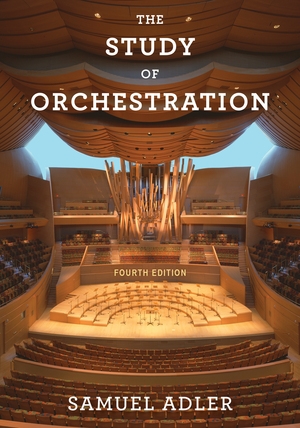
Samuel Adler
The Study of Orchestration
The book that set the standard for orchestration texts
- Formation Arranger
- Compositeur Samuel Adler
- Édition Livre et Online Audio
- Maison d’Édition W. W. Norton & Co.
- N ° de commande 9780393600520
 disponible
sera expédié dans 1-2 jours ouvrables
TVA incluse,
Hors frais de port
- Carte de crédit
- La facture
- PayPal
- Sepa
Non disponible dans tous les pays. Apprendre encore plus
Description:
- Langue: anglais
- Pages: 1024
- Parution: 06.01.2016
- Dimensions: 205 x 254 mm
- Catégorie: Méthodes d'apprentissage
- ISBN: 9780393600520
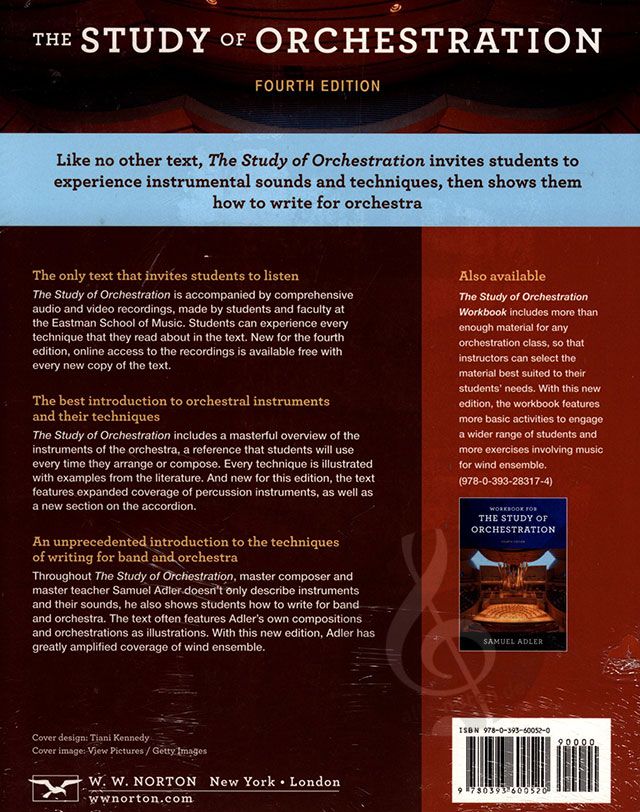
Écrit par un compositeur de renom dont les œuvres ont été interprétées par les plus grands orchestres du monde, The Study of Orchestration est le seul texte qui explore les caractéristiques des instruments d'orchestre et montre aux étudiants comment un maître compositeur aborde l'orchestration. La quatrième édition invite les étudiants à faire l'expérience des instruments grâce à des enregistrements audio et vidéo en ligne et offre désormais une plus grande couverture de l'écriture pour orchestre. L'accès aux enregistrements est inclus dans chaque nouvel exemplaire.
-
Part 1. Instrumentation
-
1. The Orchestra Yesterday and Today
-
2. Bowed String Instruments
-
Construction
-
Tuning
-
Fingering
-
Double, Triple, and Quadruple Stops
-
Divided Strings
-
Vibrato
-
Glissando and Portamento
-
The Bow
-
Bowing
-
Special On-the-String Bowings
-
Special Off-the-String Bowings
-
Trills and Other Coloristic Effects Using the Bow
-
Coloristic Effects without the Bow
-
Mutes
-
Scordatura
-
Harmonics
-
Contemporary String Techniques
-
3. Individual Bowed String Instruments
-
Violin
-
Viola
-
Violoncello or Cello
-
Double Bass
-
4. Plucked String Instruments
-
Harp
-
Guitar
-
Mandolin
-
Banjo
-
Zither
-
5. Scoring for String
-
Individuality within the Ensemble
-
Foreground - Middleground - Background
-
Contrapuntal Writing for Strings
-
Homophonic Writing for Strings
-
Using the String Choir to Accompany a Soloist
-
Transcribing from Piano to Strings
-
6. The Woodwind Choir (Reed Aerophones)
-
Construction
-
Classifying Woodwind Instruments
-
The Principle of Transposition
-
Playing Techniques
-
The Woodwind Section of a Symphony Orchestra
-
Scoring for Woodwind Instruments
-
7. Individual Woodwinds
-
Flute
-
Piccolo
-
Alto Flute
-
Bass Flute
-
Oboe
-
English Horn
-
Other Members of the Oboe Family
-
Clarinet
-
Piccolo Clarinet: Clarinet in D or E-flat
-
Bass Clarinet
-
Others Members of the Clarinet Family
-
Saxophone
-
Bassoon
-
Contrabassoon
-
8. Scoring for Woodwinds and Woodwind-String Combinations
-
The Role of Winds in the Symphony Orchestra
-
The Variety of Orchestral Treatments
-
Homophonic Writing for Winds
-
Contrapuntal Writing for Winds
-
Using the Wind Choir to Provide a Contrasting Color
-
Using the Wind Choir to Double Other Instruments of the Orchestra
-
New Types of Articulations For Woodwinds
-
Special Effects
-
Transcribing from Piano to Winds and Strings
-
9. Introduction to Brass Instruments
-
Composition of the Brass Section
-
Brass Instruments and the Written Orchestral Score
-
Overblowing and the Principle of the Harmonic Series
-
Crooks, Valves, and Slides
-
Range
-
Tone Production, Articulation, and Tonguing
-
Common Characteristics and Effects on All Brass Instruments
-
Mutes
-
Muting Devices Other Than Mutes
-
10. Individual Brass Instruments
-
Horn
-
Trumpet
-
Cornet
-
Other Members of the Trumpet Family
-
Trombone
-
Other Members of the Trombone Family
-
Tuba
-
Other Members of the Tuba Family
-
11. Scoring for Brass, and Brass Combined with Strings and Winds
-
Early Uses of the Brass Choir
-
Doubling of Brass Instruments within the Modern Orchestra
-
Homophonic Writing for the Brass Choir
-
Using the Brass Choir to Present the Melody
-
Contrapuntal Writing for the Brass Choir
-
Climactic Uses of the Brass Choir
-
Using the Brass Choir to Provide a Coloristic Effect
-
12. The Percussion Ensemble
-
Historical Uses of Percussion Instruments within the Orchestra
-
Number and Distribution of Percussion Players
-
Notation of Percussion Instruments
-
Mallets, Beaters, and Sticks
-
Categories of Percussion Instruments
-
Instruments of Definite Pitch
-
Instruments Of Indefinite Pitch
-
13. Keyboard Instruments
-
Piano
-
Celesta
-
Harpsichord
-
Organ
-
Harmonium
-
14. Scoring for Percussion with Keyboard Alone or in Combination
-
Percussion Layout in the Full Score
-
Percussion Section Setup
-
Uses of the Percussion Section
-
Part 2. Orchestration
-
15. Scoring for Orchestra
-
The Unison-Octave Tutti
-
The Distribution of Foreground - Middleground - Background Elements within the Orchestra Orchestrating a Melody or Primary Gesture
-
Using the Orchestra to Create Special Effects
-
16. The Orchestra as Accompanist
-
The Concerto
-
Accompanying the Vocal Soloist, Ensemble, or Chorus
-
17. Transcribing for Orchestra
-
Transcribing from Keyboard or Small Chamber Combinations to Orchestra
-
Transcribing from Band or Wind Ensemble to Orchestra
-
Transcribing to Various Available Instrumental Combinations
-
18. The Preparation of Score and Parts
-
The Orchestral Score Setup
-
The Reduced Score
-
The Condensed Score
-
Preparing Individual Parts
-
19. Scoring for Band or Wind Ensemble
-
Scoring for Band
-
Band Versus Wind Ensemble
-
The Percussion Section within the Band or Wind Ensemble
-
The Band and Wind Ensemble Score Setup
-
Condensed Score
-
Transcribing from Orchestra to Band or Wind Ensemble
Les clients ont évalué ce produit:
Aucune évaluation n'est disponible.
Informations du Fabricant:
W. W. Norton & Co.
500 Fifth Avenue
NY 10110
New York
Vereinigte Staaten