
Pelle Gudmundsen-Holmgreen
Still. Leben
Pelle Gudmundsen-Holmgreen
Still. Leben
- Formation Orgue
- Compositeur Pelle Gudmundsen-Holmgreen
-
Niveau de difficulté
- Édition Partition
- Maison d’Édition Edition Wilhelm Hansen
- N ° de commande WH30534
 sera expédié dans 2-4 semaines
TVA incluse,
Hors frais de port
Non disponible dans tous les pays. Apprendre encore plus
Description:
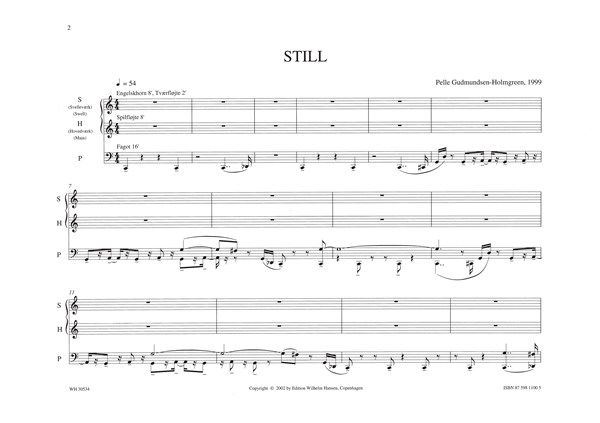
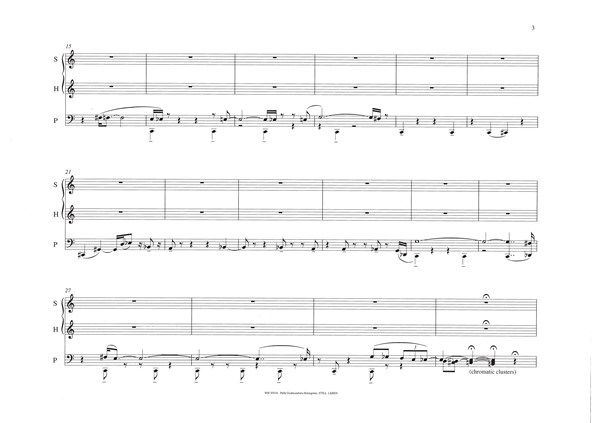
STILL. LEBEN
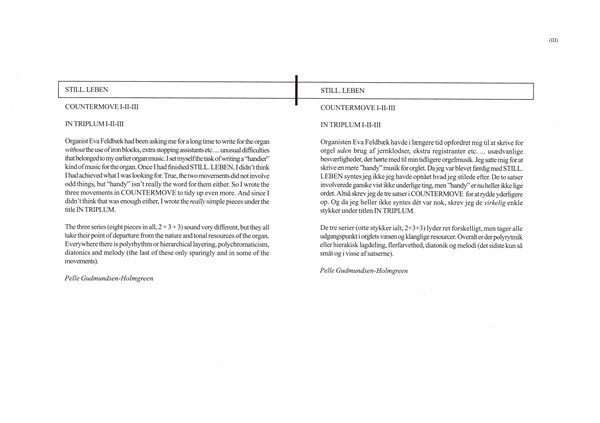
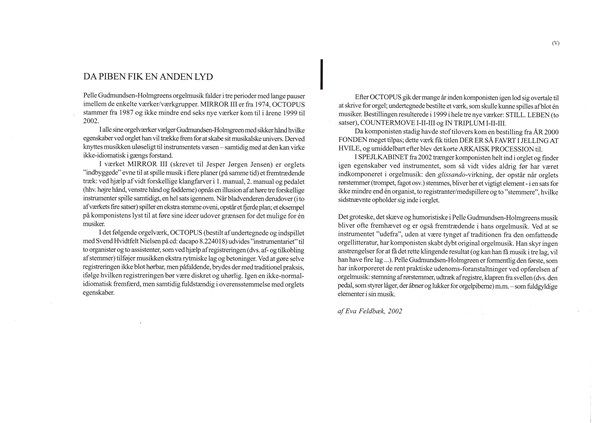
Organist Eva Feldbc:ek had been asking me for a long time to write for the organ without the use of iron blocks, extra stopping assistants etc... unusual difficulties that belonged to my earlier organ music. I setmyselfthe task of Miting a ''handier'' kind of music for the organ.
Once I had finished STILL. LEBEN, I didn't think I had achieved what I was looking for. True, the two movements did not involve odd things, but 'handy' isn't really the word for them either. So I wrote the three movements in COUNTERMOVE to tidy up even more.
And since I didn't think that was enough either, I wrote the really simple pieces under the title IN TRIPLUM.
The three series (eight pieces in all, 2 + 3 + 3) sound very different, but they all take their point of departure from the nature and tonal resources of the organ.
Everywhere there is polyrhythm or hierarchical layering, polychromaticism, diatonics and melody (the last of these only sparingly and in some of the movements).
Pelle Gudmundsen-Holmgreen
Organist Eva Feldbc:ek had been asking me for a long time to write for the organ without the use of iron blocks, extra stopping assistants etc... unusual difficulties that belonged to my earlier organ music. I setmyselfthe task of Miting a ''handier'' kind of music for the organ.
Once I had finished STILL. LEBEN, I didn't think I had achieved what I was looking for. True, the two movements did not involve odd things, but 'handy' isn't really the word for them either. So I wrote the three movements in COUNTERMOVE to tidy up even more.
And since I didn't think that was enough either, I wrote the really simple pieces under the title IN TRIPLUM.
The three series (eight pieces in all, 2 + 3 + 3) sound very different, but they all take their point of departure from the nature and tonal resources of the organ.
Everywhere there is polyrhythm or hierarchical layering, polychromaticism, diatonics and melody (the last of these only sparingly and in some of the movements).
Pelle Gudmundsen-Holmgreen