
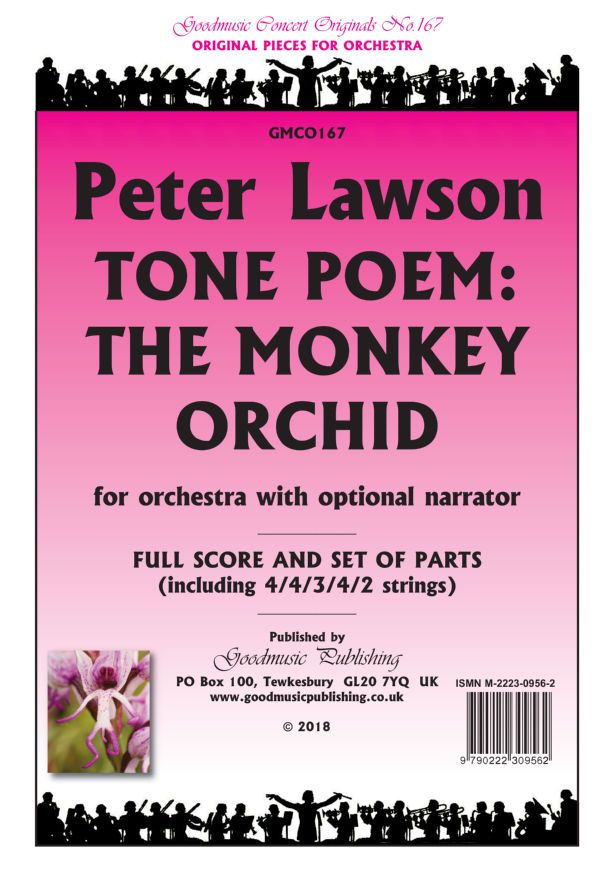
Peter Lawson
Tone Poem: The Monkey Orchid
for orchestra with optional Narrator
Démo
écouter
PDF
voir
Peter Lawson
Tone Poem: The Monkey Orchid
for orchestra with optional Narrator
- Formation Narrateur et Orchestre
- Compositeur Peter Lawson
- Édition Conducteur et parties
- Maison d’Édition Goodmusic Publishing
- N ° de commande GMCO167
 sera expédié dans 2-4 semaines
TVA incluse,
Hors frais de port
Non disponible dans tous les pays. Apprendre encore plus

Description:
Orchestration:
2 Flutes (2nd db.Piccolo), 2 Oboes, 2 Clarinets in Bb, 2 Bassoons, 4 Horns in F, 2 Trumpets in Bb, 3 Trombones, Tuba, Timpani, Percussion [2 players: Bass Drum, Cymbals (clashed and suspended), swannee Whistle, Glockenspiel, Xylophone], Harp
Strings (Violin 1, Violin 2, Viola, Cello, Bass)
Narrator (optional)
The 'Tone Poem: The Monkey Orchid', with optional narrator, is the final piece to be written in a cycle of musical portraits of the forty-eight wild orchids of Great Britain and Ireland for various instrumental and orchestral combinations. This work exists also as a 'Piano Sonata - A Portrait of the Monkey Orchid' (GM251), from which the tone poem was orchestrated.
The Monkey Orchid, 'Orchis simia', has a raggle-taggle spike of pinkish-white flowers at the top of the stem, which is anything from ten centimetres to half a metre in height. On closer inspection, each individual flower bears a striking resemblance to a spider monkey, wearing long, dark-red gloves and socks on its slender arms and legs.
The music is in four continuous movements. The first of these is a Prelude in Sonata form called 'Song of the Monkey Orchid'. At the end of the movement, the narrative begins, the second movement being entitled 'The Story of the Orchid's Decline', chronicling the discovery of the orchid in the seventeenth-century in Oxfordshire and the much rarer appearances of the Orchid in Kent. In one secret Kent site, orchid enthusiasts' joy in seeing the first Monkey Orchid for a century and a half, was short-lived, as the plant was subsequently eaten by a horse! If only the horse could have understood what it had done!
The third movement, 'Conservation and the Road Back', chronicles the hard work undertaken by naturalists in both counties with sites protected from the grazing of rabbits - and horses! The fourth movement, 'Celebrating with the Monkeys', is a short romp, incorporating a certain amount of ‘monkeying about'! 'Peter Lawson'
'Duration 15 minutes'
2 Flutes (2nd db.Piccolo), 2 Oboes, 2 Clarinets in Bb, 2 Bassoons, 4 Horns in F, 2 Trumpets in Bb, 3 Trombones, Tuba, Timpani, Percussion [2 players: Bass Drum, Cymbals (clashed and suspended), swannee Whistle, Glockenspiel, Xylophone], Harp
Strings (Violin 1, Violin 2, Viola, Cello, Bass)
Narrator (optional)
The 'Tone Poem: The Monkey Orchid', with optional narrator, is the final piece to be written in a cycle of musical portraits of the forty-eight wild orchids of Great Britain and Ireland for various instrumental and orchestral combinations. This work exists also as a 'Piano Sonata - A Portrait of the Monkey Orchid' (GM251), from which the tone poem was orchestrated.
The Monkey Orchid, 'Orchis simia', has a raggle-taggle spike of pinkish-white flowers at the top of the stem, which is anything from ten centimetres to half a metre in height. On closer inspection, each individual flower bears a striking resemblance to a spider monkey, wearing long, dark-red gloves and socks on its slender arms and legs.
The music is in four continuous movements. The first of these is a Prelude in Sonata form called 'Song of the Monkey Orchid'. At the end of the movement, the narrative begins, the second movement being entitled 'The Story of the Orchid's Decline', chronicling the discovery of the orchid in the seventeenth-century in Oxfordshire and the much rarer appearances of the Orchid in Kent. In one secret Kent site, orchid enthusiasts' joy in seeing the first Monkey Orchid for a century and a half, was short-lived, as the plant was subsequently eaten by a horse! If only the horse could have understood what it had done!
The third movement, 'Conservation and the Road Back', chronicles the hard work undertaken by naturalists in both counties with sites protected from the grazing of rabbits - and horses! The fourth movement, 'Celebrating with the Monkeys', is a short romp, incorporating a certain amount of ‘monkeying about'! 'Peter Lawson'
'Duration 15 minutes'