
Witold Lutoslawski
Symphonic Variations
for Orchestra
Witold Lutoslawski
Symphonic Variations
for Orchestra
- Formation Orchestre
- Compositeur Witold Lutoslawski
-
Niveau de difficulté
- Édition Partition
- Maison d’Édition Chester Music
- N ° de commande CH60922
 sera expédié dans 3-6 jours ouvrables
TVA incluse,
Hors frais de port
Non disponible dans tous les pays. Apprendre encore plus

Description:
Internationally renowned Polish composer Witold Lutoslawski created this impressive and deceptively folk-like Orchestral work when he was a very young composer and it propelled him into the first ranks of young composers intheearly part of the 20th century.
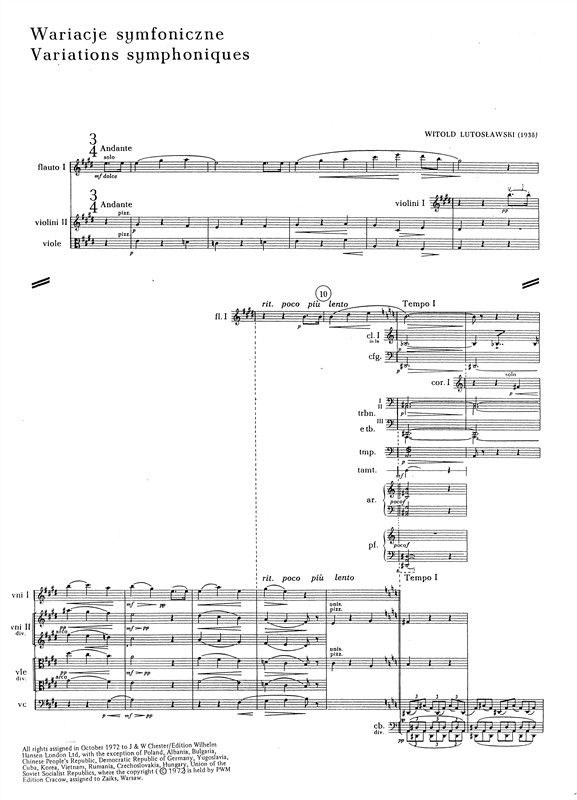
In recent years, Lutoslawki's music has begun to enjoy a reassessment after a few years of recession following his death in 1994. The piece begins with suggestions of folkloric influences, butrapidly undergoes a transformation into something deeper, more meaningful and ultimately more rewarding. The Symphonic Variations is a rare survivor of Lutoslawski's early work as Poland suffered Nazi occupation followedbydecades of Soviet dominance, and the composer had to contend with survival for a time by playing Piano with composer Andrzej Panufnik in the bars and café's of Warsaw. He fled Warsaw in 1944 with very few scores, of whichthisis one. Even the graphic arrangement of the score underlines its modernity, with blank white spaces during passages of rest and large superscript time signatures, of particular value to the conductor during passages where thetimechanges in each bar.
In recent years, Lutoslawki's music has begun to enjoy a reassessment after a few years of recession following his death in 1994. The piece begins with suggestions of folkloric influences, butrapidly undergoes a transformation into something deeper, more meaningful and ultimately more rewarding. The Symphonic Variations is a rare survivor of Lutoslawski's early work as Poland suffered Nazi occupation followedbydecades of Soviet dominance, and the composer had to contend with survival for a time by playing Piano with composer Andrzej Panufnik in the bars and café's of Warsaw. He fled Warsaw in 1944 with very few scores, of whichthisis one. Even the graphic arrangement of the score underlines its modernity, with blank white spaces during passages of rest and large superscript time signatures, of particular value to the conductor during passages where thetimechanges in each bar.