
Christoph Graupner
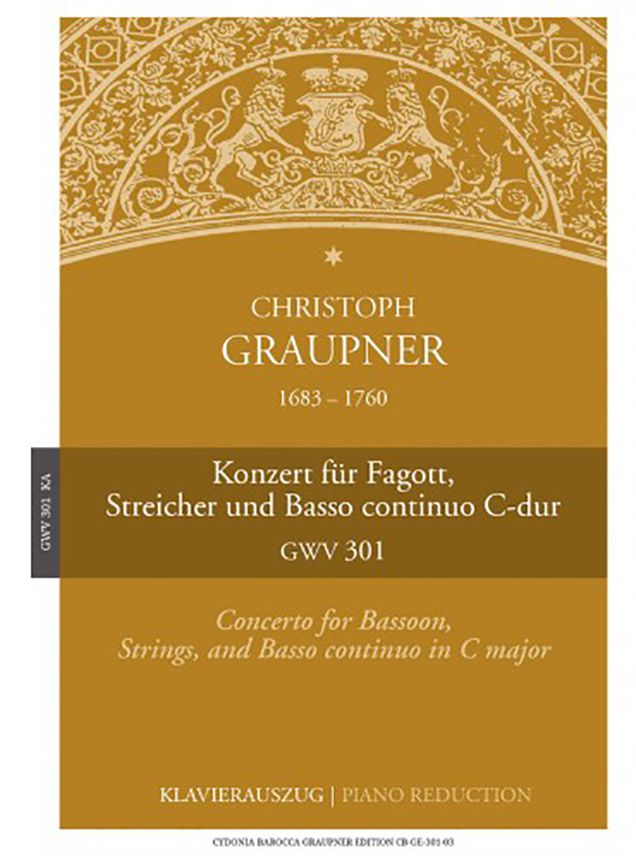
Konzert C-dur GWV 301
für Flöte, Streicher und Basso continuo (Klavierauszug)
PDF
voir
Christoph Graupner
Konzert C-dur GWV 301
für Flöte, Streicher und Basso continuo (Klavierauszug)
- Formation Flûte traversière, Orchestre à Cordes et Basse continue
- Compositeur Christoph Graupner
- Éditeur Ursula Kramer Florian Heyerick
-
Niveau de difficulté
- Édition Réduction piano
- Maison d’Édition Christoph Graupner Gesellschaft
- N ° de commande GRM-CB-GE-301-03
 disponible
sera expédié dans 1-2 jours ouvrables
TVA incluse,
Hors frais de port
Non disponible dans tous les pays. Apprendre encore plus

Description:
Piano reduction , Klavierauszug of Concerto in C major GWV 301 for Bassoon and Piano - with seperate bassoon part
Among his solo concertos, the four works for solo bassoon are particularly significant: he did not assign more soloistic tasks to any other instrument.
The Concerto in C major GWV 301 can be characterized as an overtly expressive work. In the opening movement, a stormy Vivace, the solo instrument showcases a particularly interesting playing technique – unlike in the final movement, where the bassoon carries the primary melodic material. In the first movement, Graupner (or Klotsch?) also loves to climb down to the lowest possible note on the instrument, the contra B-flat, and to relish holding it prior to expanding the tonal range to the octave above. A sharp contrast to the sections that frame the concerto is provided by the second movement, Largo e giusto. Set in the relative minor key, it breathes something open and free, if not incoherent into the main musical action, before the third movement rouses the crowd by pointedly and compactly communicating the pure joy of playing.
Among his solo concertos, the four works for solo bassoon are particularly significant: he did not assign more soloistic tasks to any other instrument.
The Concerto in C major GWV 301 can be characterized as an overtly expressive work. In the opening movement, a stormy Vivace, the solo instrument showcases a particularly interesting playing technique – unlike in the final movement, where the bassoon carries the primary melodic material. In the first movement, Graupner (or Klotsch?) also loves to climb down to the lowest possible note on the instrument, the contra B-flat, and to relish holding it prior to expanding the tonal range to the octave above. A sharp contrast to the sections that frame the concerto is provided by the second movement, Largo e giusto. Set in the relative minor key, it breathes something open and free, if not incoherent into the main musical action, before the third movement rouses the crowd by pointedly and compactly communicating the pure joy of playing.