
Anton Bruckner
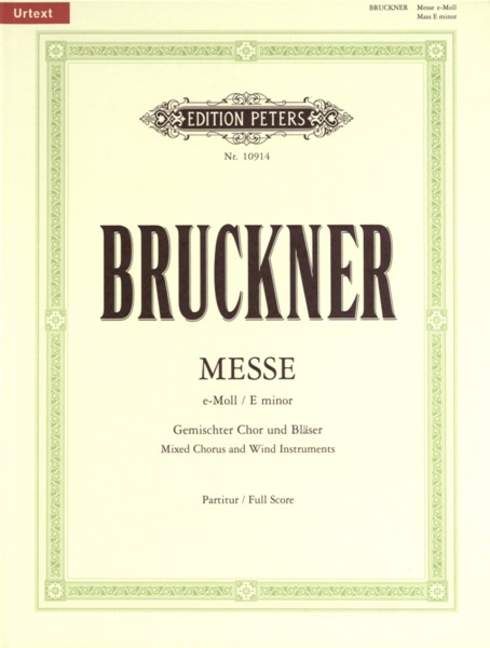
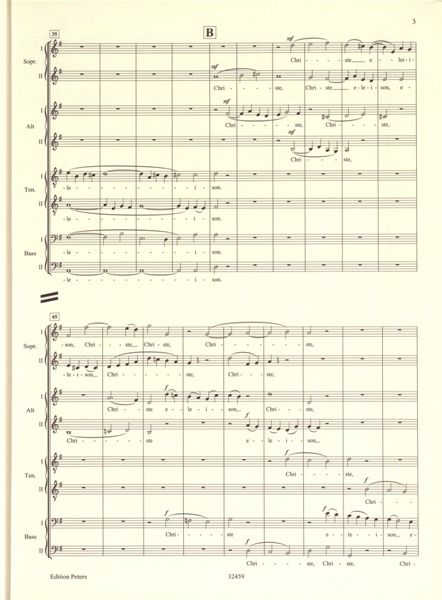
Mass No. 2 in E minor
for 8-Part Mixed Choir and Winds (New Edition based on the Sources)


Anton Bruckner
Mass No. 2 in E minor
for 8-Part Mixed Choir and Winds (New Edition based on the Sources)
- Compositeur Anton Bruckner
- Éditeur Rüdiger Bornhöft
- Édition Partition (Urtext)
- Maison d’Édition Edition Peters
- N ° de commande EP10914
 disponible
sera expédié dans 1-2 jours ouvrables
TVA incluse,
Hors frais de port
Non disponible dans tous les pays. Apprendre encore plus

Description:
When the E minor Mass was premiered in Linz it was heard in its first version. Bruckner made several changes to this version in 1876 and 1882: he reviewed its architecture and phrase structure and improved the melodic writing and the instrumentation in several passages.
The second version, completed in July 1882, is generally preferred today and forms the basis of the present edition. It received its first public hearing in the composer's presence on October 4, 1885, when it was given in the Old Cathedral at the conclusion of the centennial celebrations for the Linz bishopric.
Of the three Mass settings that Bruckner produced in Linz, the Mass No. 2 in E minor occupies a special position. If the orchestral Masses in D minor and F minor are dominated by the ethos of the classical symphony, the uniqueness of the E minor Mass resides in its blend of the ancient Palestrina style and a modern nineteenth century treatment of the instruments.
All in all, Bruckner's three great settings of the Mass from 1864 to 1868 form an impressive route to the monumental symphonies which were to follow and which form the actual basis of his fame.
The second version, completed in July 1882, is generally preferred today and forms the basis of the present edition. It received its first public hearing in the composer's presence on October 4, 1885, when it was given in the Old Cathedral at the conclusion of the centennial celebrations for the Linz bishopric.
Of the three Mass settings that Bruckner produced in Linz, the Mass No. 2 in E minor occupies a special position. If the orchestral Masses in D minor and F minor are dominated by the ethos of the classical symphony, the uniqueness of the E minor Mass resides in its blend of the ancient Palestrina style and a modern nineteenth century treatment of the instruments.
All in all, Bruckner's three great settings of the Mass from 1864 to 1868 form an impressive route to the monumental symphonies which were to follow and which form the actual basis of his fame.
Les clients ont évalué ce produit:
Informations du Fabricant:
Faber Peters Music Distribution
Talstr. 10
04103
Leipzig
Deutschland
D'autres clients ont également acheté:
Johann Sebastian Bach
Cantate pour le premier dimanche de l'Avent
- 4 Solistes, Choeur mixte (SATB) et Piano
- Réduction piano
- Günter Raphael
-
sera expédié dans 2-4 jours ouvrables
- Aussi disponible en téléchargement !
Anton Bruckner
for 8-Part Mixed Choir and Winds (New Edition based on the Sources)
- Chœur mixte (SATB) et Piano
- Réduction piano (Urtext)
-
disponible
sera expédié dans 1-2 jours ouvrables
- Soliste, Chœur mixte (SATB) et Orgue
- Extrait de l'orgue
-
disponible
sera expédié dans 1-2 jours ouvrables - Aussi disponible en téléchargement !