
Leopold Hofmann
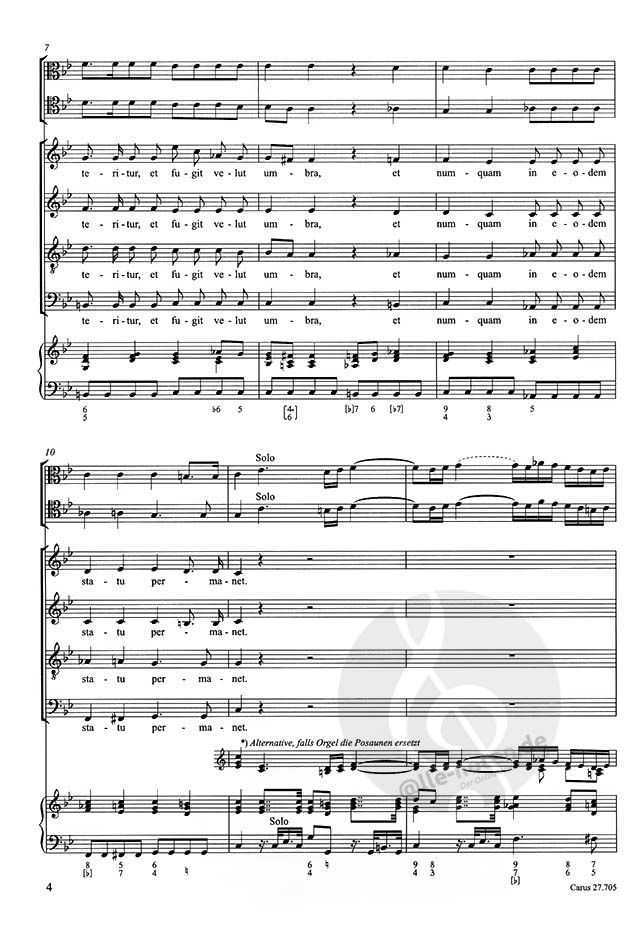
Homo natus de muliere - Choral Score
For Choir (SATB), 2 Trombones (or Violas) and Organ (First edition)

- Formation Choeur mixte (SATB), 2 Trombones et Orgue
- Formation optionnelle Choeur mixte (SATB), 2 Altos et Orgue
- Édition Partition de chœur
- Compositeur Leopold Hofmann
- Maison d'Édition Carus-Verlag
- Éditeur Guido Erdmann
- N ° de commande CV27705-05
 sera expédié dans 2-5 jours ouvrables
| à partir de | unités | Prix |
|---|---|---|
| 40 | 40+ | 2,88 € |
| 60 | 60+ | 2,56 € |
Description:
Hofmann's setting, in C minor, offers an austere harmony, characterized by suspensions in a homophonic, through-composed four-part vocal setting (soloists or SATB choir), reinforced only by two trombones and organ continuo. Four concise instrumental transitional passages between the individual verses relieve the pathos laden Viennese church style of this composition. With its tragic air, in some passages it closely resembles Mozart's Requiem K. 626.
For this first edition, the two trombone parts are available both in the original clef and in alto clef. The figured bass has been realized so that the piece can also be performed without trombones, with only organ accompaniment.
For a performance this piece could easily be combined with the Salve Regina by Pietro Cassati (CV27703) from the Vienna series.
Sielminger Str. 51
70771
Leinfelden-Echterdingen
Deutschland
alle-noten.de: Partitions depuis 1969

Depuis 1969, plus de 500 000 clients nous font confiance. Avec un vaste choix de plus de 1 000 000 partitions, nous sommes l'un des plus grands fournisseurs d'Europe. Grâce à notre grand stock, nous pouvons souvent expédier les partitions sous 24 heures. Quelles que soient les partitions que vous recherchez, vous êtes au bon endroit !
Votre Stefanie Reichert
Responsable du service client
Produits liés:

- Choeur mixte (SATB), 2 Trombones et Orgue
- Partition
- Carus-Verlag
-
sera expédié dans 2-5 jours ouvrables

- Choeur mixte (SATB), 2 Trombones et Orgue
- Partie seule Orgue
- Carus-Verlag
-
sera expédié dans 2-5 jours ouvrables
- Choeur mixte (SATB), 2 Trombones et Orgue
- Set de parties
- Carus-Verlag
-
sera expédié dans 2-5 jours ouvrables