
Peter Schindler
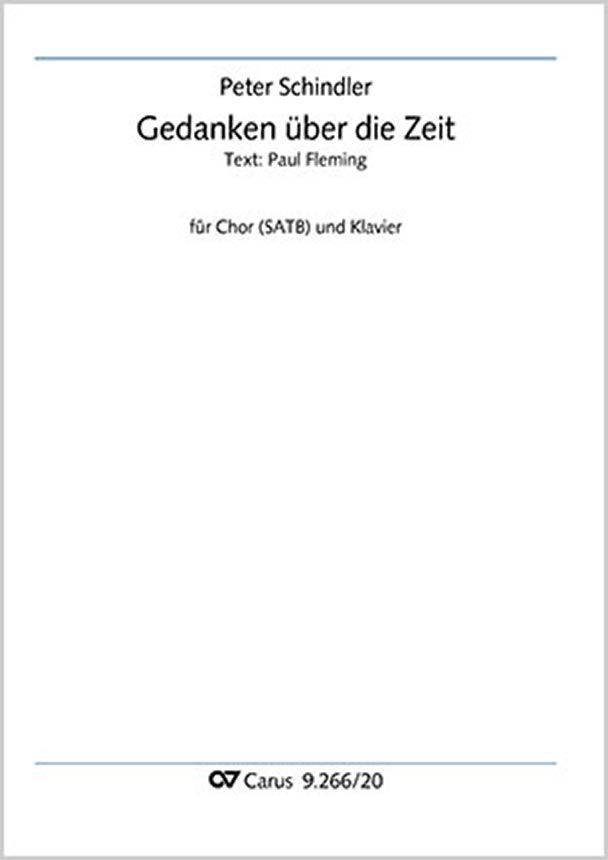
Gedanken über die Zeit
de: Sonne, Mond und Sterne
Démo
écouter
PDF
voir
Peter Schindler
Gedanken über die Zeit
de: Sonne, Mond und Sterne
- Formation Chœur mixte (SATB) et Piano
- Compositeur Peter Schindler
-
Niveau de difficulté
- Édition Partition piano à télécharger
- Maison d’Édition Carus-Verlag
- N ° de commande CV09266-20-DL
 disponible immédiatement
Télécharger immédiatement après la commande
TVA incluse,
Hors frais de port
- Échelle de quantité:
- àpd 30 unités 3,42 €
- àpd 50 unités 3,04 €
- àpd 100 unités 2,85 €
Non disponible dans tous les pays. Apprendre encore plus
Description:
Peter Schindler's full-length secular choral work Sonne, Mond und Sterne (Sun, Moon and Stars) narrates a love story based on 'old' texts which are given a new interpretation through these musical settings. Some individual numbers were published in spring, and now more movements with piano accompaniment are available in print and digitally.
choral work of medium difficulty
will appeal to experienced Brahms Requiem singers as well as ambitious chamber or youth choirs with a gospel, pop or jazz background
cross-over between jazz, chanson, and chamber music
Peter Schindler about Gedanken über die Zeit:
Paul Fleming was one of the most important lyric poets in German Baroque literature. He wrote his poem Gedanken über die Zeit in his early twenties; it was first published in 1634 as an epitaph. All the nuances of the concept of time are artistically contrasted, and the motif 'Zeit' (time) is explored and played with in a dialectical manner.
The male voices begin in unison at an andante maestoso tempo, followed by a leisurely progress in homophonic writing in a slightly freer rhythm. A lively middle section follows which leads into the opening motif again in the last section. The third section contains a fugue, and the end is unison once again. And so the words are like a manifesto by the poet.
choral work of medium difficulty
will appeal to experienced Brahms Requiem singers as well as ambitious chamber or youth choirs with a gospel, pop or jazz background
cross-over between jazz, chanson, and chamber music
Peter Schindler about Gedanken über die Zeit:
Paul Fleming was one of the most important lyric poets in German Baroque literature. He wrote his poem Gedanken über die Zeit in his early twenties; it was first published in 1634 as an epitaph. All the nuances of the concept of time are artistically contrasted, and the motif 'Zeit' (time) is explored and played with in a dialectical manner.
The male voices begin in unison at an andante maestoso tempo, followed by a leisurely progress in homophonic writing in a slightly freer rhythm. A lively middle section follows which leads into the opening motif again in the last section. The third section contains a fugue, and the end is unison once again. And so the words are like a manifesto by the poet.
Voici comment fonctionne le téléchargement :
1 Acheter la partition à télécharger
Achetez la partition à télécharger dans notre boutique en ligne.
2 Confirmation de commande avec lien de téléchargement
Dès la finalisation de votre commande, vous recevrez une confirmation par e-mail récapitulant tous les articles. Vous trouverez le lien de téléchargement à côté de chaque article. Ce lien vous permet de lancer le téléchargement immédiatement. Veuillez également vérifier votre dossier spam si nécessaire.
Les clients ont évalué ce produit:
Informations du Fabricant:
Carus-Verlag GmbH & Co. KG
Sielminger Str. 51
70771
Leinfelden-Echterdingen
Deutschland
Produits liés:

- Voix moyenne et Piano
- Partition piano à télécharger
- Carus-Verlag
-
-
disponible immédiatement
Télécharger immédiatement après la commande - Téléchargement instantané
- Voix moyenne et Piano
- Partition piano
- Carus-Verlag
-
-
sera expédié dans 2-5 jours ouvrables
- Aussi disponible en téléchargement !
- Chœur mixte (SATB) et Piano
- Partition piano
- Carus-Verlag
-
-
sera expédié dans 2-5 jours ouvrables
- Aussi disponible en téléchargement !
- Chœur mixte (SATB) et Piano
- Partition piano
- Carus-Verlag
-
-
sera expédié dans 2-5 jours ouvrables
- Aussi disponible en téléchargement !
- Chœur mixte (SATB) et Piano
- Partition piano
- Carus-Verlag
-
-
sera expédié dans 2-5 jours ouvrables
- Aussi disponible en téléchargement !
- Chœur mixte (SATB) et Piano
- Partition piano
- Carus-Verlag
-
-
sera expédié dans 2-5 jours ouvrables
- Aussi disponible en téléchargement !
- Voix moyenne, Choeur mixte (SATB) et Piano
- Partition piano à télécharger
- Carus-Verlag
-
-
disponible immédiatement
Télécharger immédiatement après la commande - Téléchargement instantané

- Chœur mixte (SATB) et Piano
- Partition piano à télécharger
- Carus-Verlag
-
-
disponible immédiatement
Télécharger immédiatement après la commande - Téléchargement instantané
- Chœur mixte (SATB) et Piano
- Partition piano à télécharger
- Carus-Verlag
-
-
disponible immédiatement
Télécharger immédiatement après la commande - Téléchargement instantané
- Voix moyenne, Choeur mixte (SATB) et Piano
- Partition piano
- Carus-Verlag
-
-
sera expédié dans 2-5 jours ouvrables
- Aussi disponible en téléchargement !
- Chœur mixte (SATB) et Piano
- Partition piano à télécharger
- Carus-Verlag
-
-
disponible immédiatement
Télécharger immédiatement après la commande - Téléchargement instantané
- Voix moyenne, Chœur mixte (SATB) et Piano
- Partition piano
- Carus-Verlag
-
-
sera expédié dans 2-5 jours ouvrables
- Aussi disponible en téléchargement !
- Voix moyenne, Choeur mixte (SATB) et Piano
- Partition piano à télécharger
- Carus-Verlag
-
-
disponible immédiatement
Télécharger immédiatement après la commande - Téléchargement instantané

- Chœur mixte (SATB) et Piano
- Partition piano
- Carus-Verlag
-
-
sera expédié dans 2-5 jours ouvrables
- Aussi disponible en téléchargement !
- Chœur mixte (SATB) et Piano
- Partition piano à télécharger
- Carus-Verlag
-
-
disponible immédiatement
Télécharger immédiatement après la commande - Téléchargement instantané

- Chœur mixte (SATB) et Piano
- Partition piano à télécharger
- Carus-Verlag
-
-
disponible immédiatement
Télécharger immédiatement après la commande - Téléchargement instantané
- Chœur mixte (SATB)
- Partition de chœur
- Carus-Verlag
-
-
sera expédié dans 2-5 jours ouvrables
- Aussi disponible en téléchargement !
- Chœur mixte (SATB)
- Partition de chœur à télécharger
- Carus-Verlag
-
-
disponible immédiatement
Télécharger immédiatement après la commande - Téléchargement instantané