
Claude Debussy
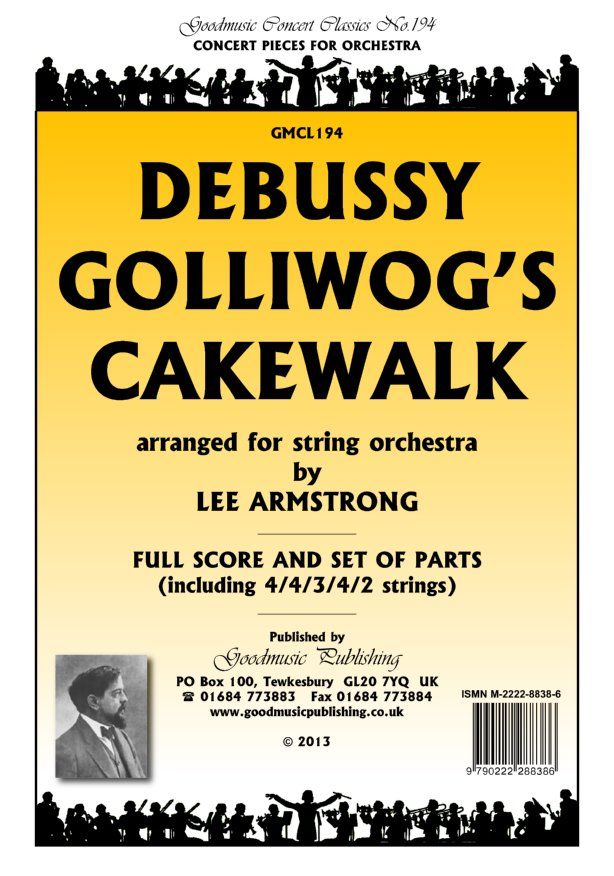
Golliwog's Cakewalk
for string orchestra
Démo
écouter
PDF
voir
Claude Debussy
Golliwog's Cakewalk
for string orchestra
- Formation Orchestre à Cordes
- Compositeur Claude Debussy
- Édition Conducteur et parties
- Maison d’Édition Goodmusic Publishing
- N ° de commande GMCL194
 sera expédié dans 2-4 semaines
TVA incluse,
Hors frais de port
Non disponible dans tous les pays. Apprendre encore plus

Description:
Orchestration: Violin 1, Violin 2, Viola, Cello, Bass
Golliwog's Cakewalk is the last in a suite of six pieces entitled 'Children's Corner' that Debussy wrote for solo piano which was published in 1908. It was dedicated to Debussy's daughter, Claude-Emma (known as 'Chou-Chou'), who was three years old at the time.
At the time of its composition, Golliwoggs were in fashion, due partly to the popularity at that time of the novels of Florence Kate Upton ('golliwog' is a later usage). They were stuffed black dolls with red pants, red bow ties and wild hair, somewhat reminiscent of the black-face minstrels of the time. This is a ragtime piece with its syncopations and banjo-like effects. The dynamic range is quite large and very effective. The second section of this dance is interrupted on several occasions by the love-death leitmotif of Richard Wagner's opera Tristan und Isolde, marked in the original avec une grande emotion (with great feeling). Each quotation is followed with banjo imitations. The cakewalk was a dance or a strut and the dancer with the most elaborate steps won a cake.
This excellent arrangement for string orchestra is by Lee Armstrong.
Duration 2 1/2 minutes
Golliwog's Cakewalk is the last in a suite of six pieces entitled 'Children's Corner' that Debussy wrote for solo piano which was published in 1908. It was dedicated to Debussy's daughter, Claude-Emma (known as 'Chou-Chou'), who was three years old at the time.
At the time of its composition, Golliwoggs were in fashion, due partly to the popularity at that time of the novels of Florence Kate Upton ('golliwog' is a later usage). They were stuffed black dolls with red pants, red bow ties and wild hair, somewhat reminiscent of the black-face minstrels of the time. This is a ragtime piece with its syncopations and banjo-like effects. The dynamic range is quite large and very effective. The second section of this dance is interrupted on several occasions by the love-death leitmotif of Richard Wagner's opera Tristan und Isolde, marked in the original avec une grande emotion (with great feeling). Each quotation is followed with banjo imitations. The cakewalk was a dance or a strut and the dancer with the most elaborate steps won a cake.
This excellent arrangement for string orchestra is by Lee Armstrong.
Duration 2 1/2 minutes