
Georg Friedrich Händel
La Bellezza ravveduta nel trionfo del Tempo e del Disinganno HWV 46a
Oratorio en deux parties

Georg Friedrich Händel
La Bellezza ravveduta nel trionfo del Tempo e del Disinganno HWV 46a
Oratorio en deux parties
- Formation Soliste (SSAT)
- Édition Réduction piano (Urtext)
- Compositeur Georg Friedrich Händel
- Éditeur Christopher Sokolowski
- Maison d'Édition Bärenreiter Verlag
- Série Bärenreiter Urtext
- Éditeur Michael Pacholke
- Parolier Benedetto Pamphili
- N ° de commande BA10721-90
TVA incluse,
Hors frais de port
 disponible
|
sera expédié dans 1-2 jours ouvrables
Description:
Handel composed his first Italian oratorio 'La Bellezza ravveduta nel trionfo del Tempo e del Disinganno' in 1707. It is based on an allegorical moral libretto written by Cardinal Benedetto Pamphili who also commissioned this work.
Disinganno (Illumination) and Tempo (Time) try to get the young, beautiful and frivolous Bellezza (Beauty) to recognise the true values of life and to act accordingly. The audience accompanies Bellezza in her spiritual development, in which she increasingly distances herself from Piacere (Pleasure) and listens more and more to Tempo and Disinganno.
The oratorio contains some of the most beautiful music Handel ever composed. This includes the enchanting aria 'Lascia la spina', in which he uses the music of the sarabande from the opera 'Almira', composed in Hamburg in 1704, and which then achieved immortal fame in 'Rinaldo' (1711) as 'Lascia ch'io pianga'.
-
Besetzung - Ensemble
-
Annette Landgraf Vorwort
-
Annette Landgraf Preface
-
Verzeichnis der Nummern - Index of numbers
-
Sonaten-Ouvertüre
-
Erster Teil
-
Zweiter Teil
-
Anhang - Appendix
Les clients ont évalué ce produit:
Bärenreiter-Verlag Karl Vötterle GmbH & Co. KG
Heinrich-Schütz-Allee 35-37
34131
Kassel
Deutschland
Partitions depuis 1969
Depuis 1969, plus de 500 000 clients nous font confiance. Avec un vaste choix de plus de 1 000 000 partitions, nous sommes l'un des plus grands fournisseurs d'Europe. Grâce à notre grand stock, nous pouvons souvent expédier les partitions sous 24 heures. Quelles que soient les partitions que vous recherchez, vous êtes au bon endroit !
Votre Stefanie Reichert
Responsable du service client
Produits liés:

- Soliste (SSAT) et Orchestre
- Partition (Urtext)
- Bärenreiter Verlag
-
sera expédié dans 2-4 jours ouvrables
D'autres clients ont également acheté:

- Piano
- Partition
- Phillip Keveren
-
sera expédié dans 3-6 jours ouvrables

- Solistes, Choeur mixte (SATB) et Orchestre à chambre
- Réduction piano
-
disponible
|
sera expédié dans 1-2 jours ouvrables
- Aussi disponible en téléchargement !

- Violon et Piano
- Réduction piano avec les voix solo
-
sera expédié dans 2-4 semaines
- Aussi disponible en téléchargement !

Giovanni Battista Viotti
- Duo de violons
- Partition
-
sera expédié dans 4-8 jours ouvrables

Giovanni Battista Viotti
- Duo de violons
- Partition
-
sera expédié dans 2-4 jours ouvrables

- Trompette et Piano
- Partition
-
sera expédié dans 3-6 jours ouvrables

Domenico Zipoli
- Piano
- Partition
-
disponible
|
sera expédié dans 1-2 jours ouvrables

- Choeur d'hommes (TTBB) et Ensemble
- Partition
-
sera expédié dans 4-8 jours ouvrables

Giovanni Battista Viotti
- Duo de violons
- Partition
-
sera expédié dans 2-4 jours ouvrables

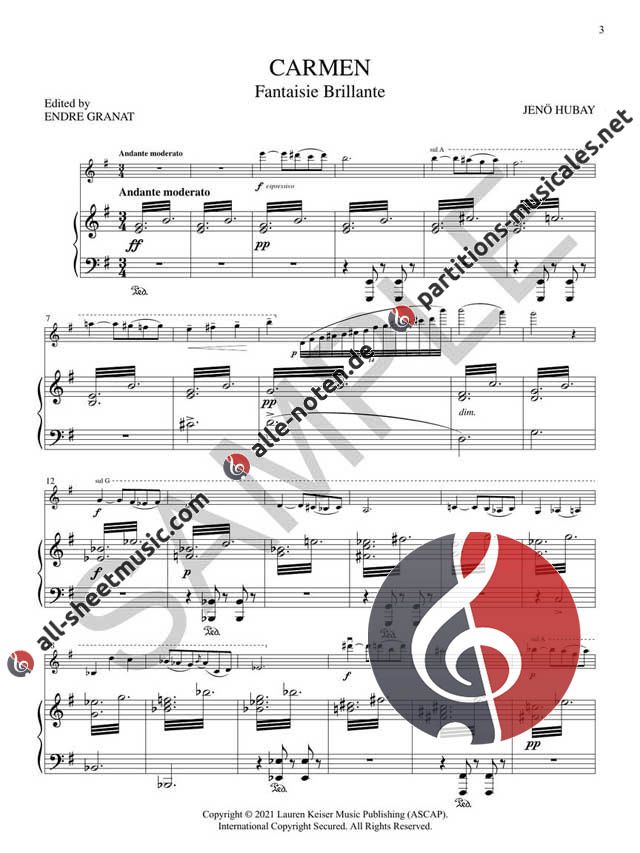
- Violon et Piano
- Partition
- Jenő Hubay
-
disponible
|
sera expédié dans 1-2 jours ouvrables

by Hubay and Sarasate for Violin and Piano
- Violon et Piano
- Partition
-
sera expédié dans 2-4 semaines

- Violon, Cor et Piano
- Conducteur et parties
-
disponible
|
sera expédié dans 1-2 jours ouvrables
- Aussi disponible en téléchargement !

Pablo de Sarasate
for violin and piano with marked and unmarked string part
- Violon et Piano
- Partition piano et partie(s) (Urtext)
- Ingolf Turban
-
disponible
|
sera expédié dans 1-2 jours ouvrables

- Orchestre
- Partition de poche
-
sera expédié dans 2-4 semaines




- Duo de violons
- Set de parties
-
disponible
|
sera expédié dans 1-2 jours ouvrables